For platforms on Adyen for Platforms

Payments, brought into focus.

The sub-merchant portal your platform is missing.

Collimate is the white-label portal your sub-merchants log into, the admin panel your team runs them from, and the onboarding flow that gets them live — for platforms already running on Adyen for Platforms.

Adyen holds the funds and owns verification. Collimate is the software layer your team and your sub-merchants work in.

Collimate as a control layer above the Adyen data planeFunds, verification and compliance run directly between Adyen and each sub-merchant. Collimate sits above that path, reading state from Adyen and issuing instructions back to it, so a platform's team and its sub-merchants get one legible view and a clear next action.
01 Adyen
02 Collimate
03 Sub-merchants

01 / The problem

Your sub-merchants have no front door.

01

The questions arrive by email or service desk

“Where is my payout? Why is my account limited? What does this status mean?” Every one of those is answerable from Adyen — but only by someone with access to it, which is your team, not the sub-merchant asking.

02

Your ops team becomes a human API

A platform on Adyen for Platforms can onboard sellers and move money the day it integrates. What it cannot do is give those sellers somewhere to look. So operations sits in front of Adyen, translating, all day.

03

A status without a reason is a support ticket

"Verification pending" tells nobody what to do next. Every status Collimate surfaces carries a reason and a next action — that is the difference between a dashboard and a queue.

02 / The answer

A front door for your sub-merchants, on top of Adyen.

Collimate is white-label software for platforms on Adyen for Platforms. It reads your Adyen account and turns it into three things: a portal your sub-merchants log into, an admin panel your team runs them from, and an onboarding flow that gets them live. Adyen still holds the funds and makes the verification decisions.

Sub-merchant portal

They look it up instead of emailing you.

Earnings after fees, transactions, payouts and verification status, on your brand and your subdomain. The answer to “where is my payout?” is already on screen.

Solves 01Questions by email

Tenant admin panel

Your team stops translating Adyen.

Every sub-merchant and the state of its onboarding in one list. Invite sellers and admins, manage credentials and see capabilities without opening Adyen.

Solves 02Ops as a human API

Onboarding flow

Every status comes with a next step.

Invited sellers complete Adyen's legal-entity form, mirrored one to one. When verification stalls, the reason and the next action are on screen for the seller and for your team.

Solves 03Statuses without reasons

See the product

03 / Fit

Who this is for?

Collimate is narrow on purpose. Below is the profile it was built around and the profiles it was not — stated here rather than discovered on a call, because a demo you should not have taken costs you more than it costs us.

You are live on, or contracted for, Adyen for Platforms
Built for
Collimate is a layer on your own Adyen setup, mirrored to its model. It is not a payment provider and not an alternative to one, so this is the one thing that cannot be worked around.
Your sub-merchants are small businesses
Built for
A salon, a clinic, an independent hotel, a restaurant, a shop. A named owner, a bank account, no finance function, and a phone rather than a desk. That is who the portal is designed around.
You have hundreds to a few thousand of them
Built for
Enough that support can no longer absorb the payment questions one at a time, not so many that you have already built a seller dashboard of your own.
Someone owns seller operations
Built for
A person whose actual job is partner or seller operations. They are the one the admin panel is for, and without them a portal gets bought and never adopted.
Sellers ask where their money is, by email
Built for
If nobody is asking, there is nothing here to fix. If your team answers it by opening Adyen on the seller's behalf, that is the workflow this replaces.
Your sellers are private individuals
Not for
Onboarding mirrors Adyen's legal-entity model, which assumes a registered business. Consumer sellers, gig workers and one-off recipients are a different product, and we would rather say so now.
Your sellers are enterprises
Not for
A business with a finance team and a general ledger wants a data feed, not somewhere to log in. The portal solves a problem they do not have.
You have a payments engineering team
Not for
If payments is something you staff rather than something you buy, you will build this, and you will build it closer to your own product than we can.
You want a theming tool to run yourself
Not for
Branding, domain and module policy are configured for you when your tenant is provisioned. That is a deliberate choice, not a gap — it is what keeps every tenant on one maintained codebase.
04 / What your sub-merchants see

Earnings, payouts, and why verification is stuck.

Tenant-branded, on your subdomain. The place a sub-merchant goes instead of emailing your team.

01

Sub-merchant portal

Built for the owner-operator who wants one number in ten seconds, and for the finance user who needs to reconcile to the cent.

  • What you earned, after fees
  • Transactions, with statuses that explain themselves
  • Payouts: what was paid, what is coming, and why an amount differs
  • Verification status with the reason and the next action
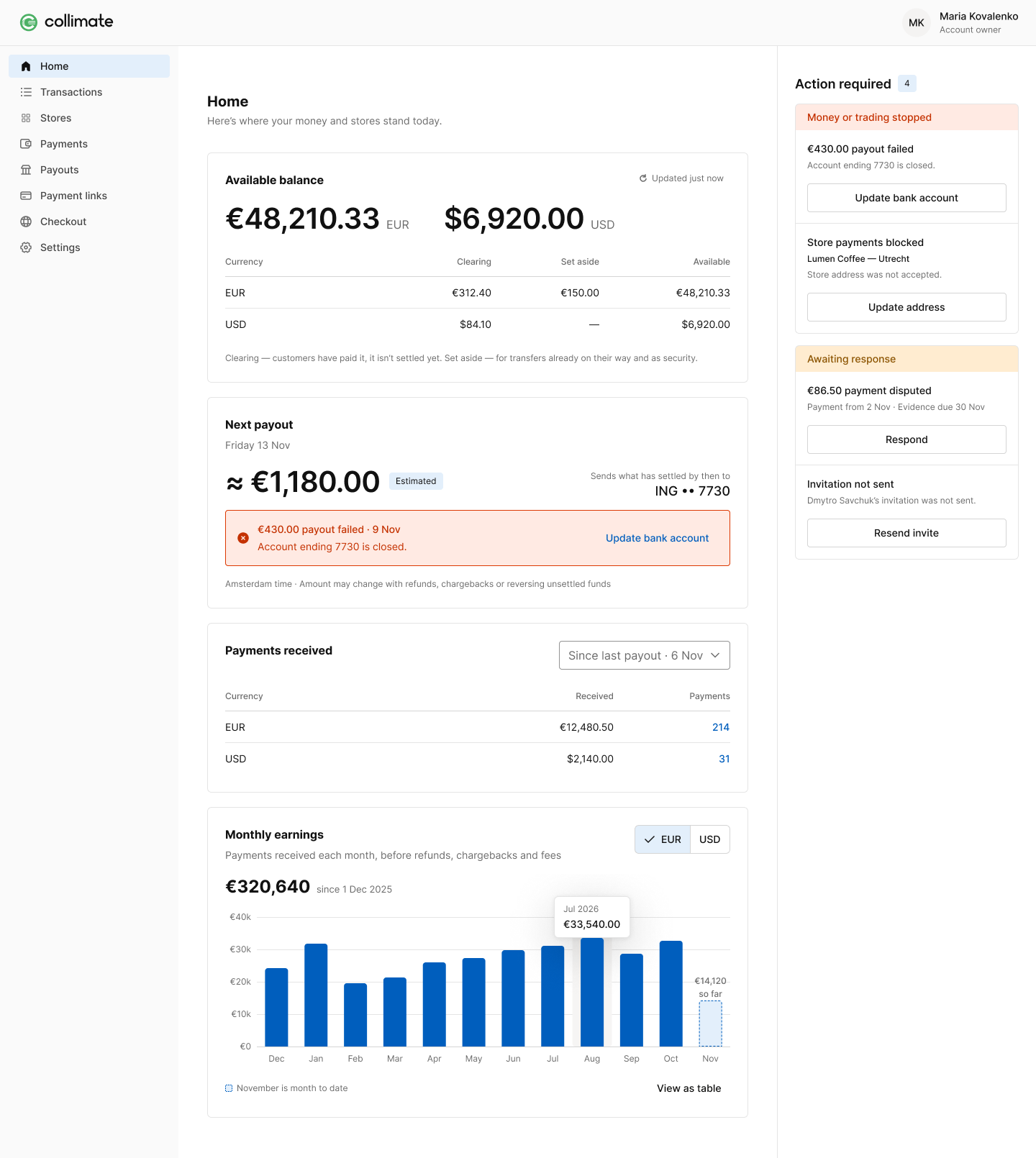
Sub-merchant dashboard
The sub-merchant dashboard: available balance, the next payout, and a failed payout with the reason and the action to fix it.123
  1. Earnings after fees. The number the owner-operator actually wants, not gross volume.
  2. Next payout. Date and amount, so “when does my money arrive” stops being an email.
  3. Status with a reason. Every status carries why it happened and what to do next.

05 / What your team gets

The pipeline, and why one is stuck.

Where your team sees every sub-merchant and the state of its onboarding — without opening an Adyen ticket.

02

Tenant admin panel

Invite a seller in under a minute. See the pipeline at a glance: invited, in progress, verified, stuck.

  • Sub-merchant list with onboarding application status
  • Invite your own admins
  • Credential setup — add, update, revoke
  • Per-sub-merchant capability visibility
  • Collimate never holds your Adyen credentials itself
  • Test and production credentials stay separated
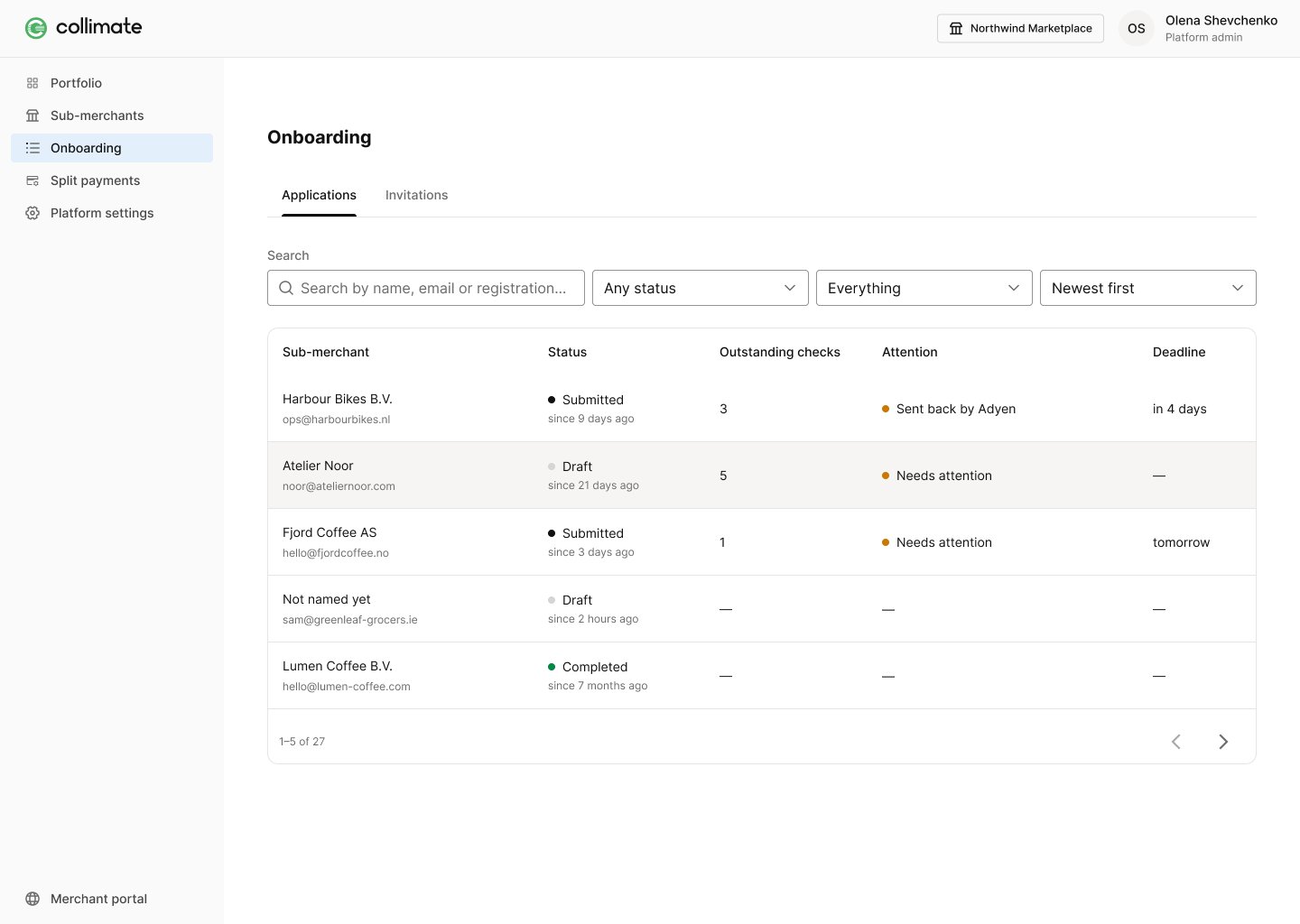
Onboarding · Applications
The tenant admin panel's onboarding applications: each sub-merchant with its status, outstanding checks and what needs attention.1234
  1. Invited. Onboarding opens only after your team sends an invite — a deliberate pre-screen.
  2. In progress. The seller is filling in Adyen's legal-entity form, mirrored one to one.
  3. Verified. Adyen has made the decision and granted capabilities; we surface the result.
  4. Needs attention. The reason is on the row, so your team can act without opening a ticket.

06 / Your brand

Your brand, your subdomain.

Your sub-merchants sign in to something that looks like you, on a dedicated subdomain we configure at setup. Tenant-managed custom domains are the target model, and are not in the first release.

03

White-label by configuration

We configure your tenant instance — branding, theme, domain and module policy. You never build or maintain a portal variant.

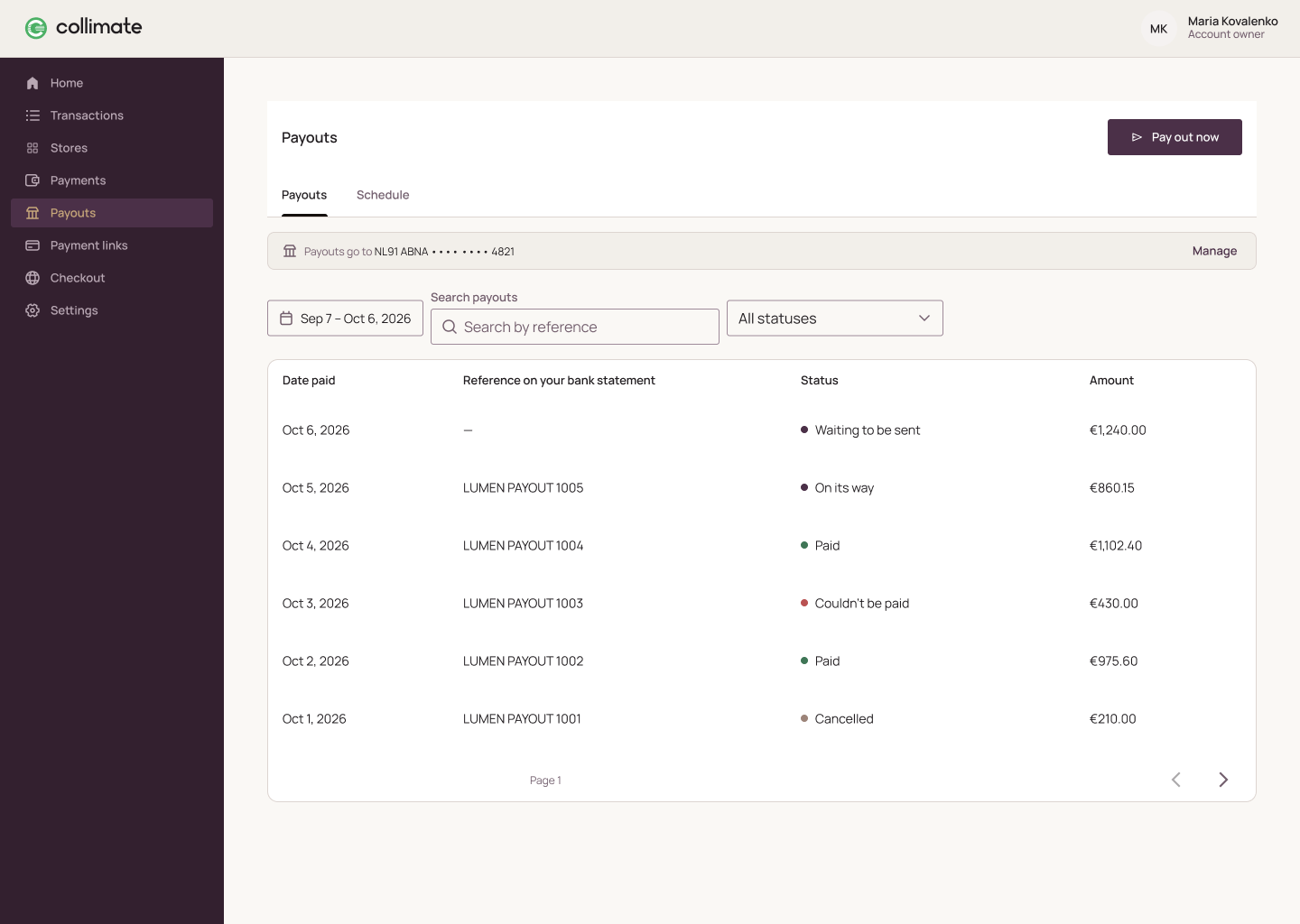
larkfield.collimate.app2
A sub-merchant portal in a platform's own branding, on its own domain, showing the payouts screen.1
  1. Your brand. Logo, palette and type, configured by us when your tenant is provisioned.
  2. Your domain.

07 / Where the truth lives

Adyen stays the system of record.

The shortest security review is the one where most of the surface does not exist. Collimate is a projection of Adyen's state, not a parallel ledger.

Funds and balances
Adyen
Collimate never receives, holds or transmits money. Balances and payouts are read through from Adyen and instructed back to it.
KYB and KYC decisions
Adyen
We collect onboarding data in Adyen's own legal-entity shape and pass it on. The verification outcome is Adyen's.
Cardholder data
Adyen
Payment interfaces are Adyen's hosted components, so card data never reaches our infrastructure and is not in our PCI scope.
Capability grants
Adyen
A capability is granted by Adyen after verification. We surface it; we do not award it.
Adyen credentials
The platform
You generate your own API keys and hand them over. We act only under the keys as given, with test and production kept apart.
The interface your users work in
Collimate
The portal, the admin panel, the onboarding flow, and the job of making an Adyen status legible enough to act on.

08 / How you go live

We configure it. Days, not a build project.

Collimate is configured, not self-service. Your tenant instance is set up for you — you are not asked to build, theme or maintain anything, which is why go-live is counted in weeks rather than quarters. Design partners are the first platforms to run it end to end.

  1. 01You

    You supply Adyen API keys

    Generated by you, in your own Adyen account, and handed over. Test and production separately.

  2. 02You

    You supply branding and policy

    Logo, palette, type, and the policy choices that decide which modules your sub-merchants get.

  3. 03Collimate

    We provision the tenant

    Instance, subdomain, TLS, theming, module flags and identity — configured by us, on a shared codebase, with no fork of the product for you to inherit.

  4. 04Collimate

    We validate on test, then switch to production

    Invite a test seller, complete onboarding, watch verification statuses flow through. Then the same loop against production keys, and your team takes over inviting.

09 / Who's behind it

Built by a team that has shipped this before.

Collimate is built by Kindgeek, a fintech software company. There is no logo wall here because we have not earned one yet — so here is the relevant prior art instead.

  • KYB onboarding flows

    Onboarding and know-your-business flows built against a regulated provider's entity model — the same handoff Collimate performs to Adyen.

  • A transaction orchestration engine

    Direct experience of the state-reconciliation problems that make payment operations hard to get right.

10 / Questions

Common questions

Do you touch our money?

No. Adyen holds the funds and remains the system of record for balances and payouts. Collimate reads that state and instructs Adyen through its APIs; money never flows through us.

Do you make verification decisions?

No. We collect onboarding data in Adyen's own legal-entity model and pass it to Adyen, which owns the decision. We surface the resulting status with enough detail for your team to act on it.

Is cardholder data ever on your systems?

No. Payment interfaces are Adyen's hosted components, so card data never reaches Collimate infrastructure.

Is it white-label?

Yes. The sub-merchant portal carries your branding on a dedicated subdomain. Branding and domain are configured for you when your tenant is provisioned, rather than being a self-service theming tool.

Do we need to already be on Adyen for Platforms?

Yes. Collimate is a layer on top of your existing Adyen for Platforms setup, not a payment provider and not an alternative to one.

How long does it take to go live?

Weeks. Provisioning your tenant is configuration — instance, subdomain, theming, module policy and identity — not a build, and the work that would make it months is work you are not asked to do. What you supply is Adyen keys, branding and policy choices; the long pole after that is your own team validating on test credentials before you switch to production.

What stage is this at?

In build, with design partners. We would rather tell you that now than have you discover it in month three.

Next step

Bring every sub-merchant into focus.

Book a demo